
They both sit on a job site. They both deal with dust. They’re both called “industrial cleaning equipment.” So what actually separates an industrial vacuum cleaner from an industrial air scrubber — and does your facility need one, the other, or both?
The short answer: they solve completely different problems. One removes debris from surfaces. The other cleans the air itself. Understanding which problem you have is the first step to choosing the right machine.
The Core Difference in One Sentence
An industrial vacuum cleaner collects debris, dust, and liquids from surfaces and deposits them into a tank.
An industrial air scrubber draws contaminated air through a filtration system and returns clean air back into the space.
The vacuum works at the source — nozzle on the floor, hose in hand. The air scrubber works on the environment — running continuously in the background, treating the air in the entire room.
How Each Machine Works
Industrial Vacuum Cleaner
An industrial vacuum creates negative pressure (suction) through one or more motors. When the nozzle is placed against a surface, air — along with any debris in its path — is drawn through the hose, through the filter, and deposited into a collection tank. The cleaned exhaust air is discharged back into the space.
Key components:
● Motor(s) generating suction
● Hose and accessories for directing suction to a specific point
● Filter to separate debris from exhaust air
● Collection tank (wet/dry models handle both liquids and solids)
The operator controls exactly where the suction is applied. This is a targeted, active cleaning tool.
Industrial Air Scrubber
An industrial air scrubber uses a fan to draw the ambient air in a room through a series of filters — typically a coarse pre-filter followed by a HEPA filter. The filtered air is then returned to the room. The machine runs continuously, cycling the air in the space multiple times per hour.
Key components:
● Fan motor creating airflow through the unit
● Multi-stage filtration (pre-filter + HEPA, rated to H13 or above)
● Ducting options for directing filtered air or creating negative pressure
● Filter alarm indicators (clog and breakage warnings)
The air scrubber doesn’t require an operator to guide it. It works passively on the entire volume of air in the space.
Side-by-Side Comparison
|
|
Industrial Vacuum |
Industrial Air Scrubber |
| What it cleans | Surfaces — floors, machines, equipment | Air — the whole room environment |
| How it works | Operator directs suction to a specific point | Runs continuously, draws room air through filters |
| Best for | Collecting debris, liquids, slurry, dust at source | Reducing airborne particulates across a space |
| Operator required? | Yes — active use | No — passive/continuous operation |
| Captures liquids? | Yes (wet/dry models) | No |
| HEPA filtration? | Some models (dust extractors) | Yes — standard feature |
| Negative pressure capability? | No | Yes — used for containment |
| Typical airflow | Measured in L/s or CFM (suction volume) | Measured in CFM (room air changes per hour) |
| Bersi product range | BF584 Wet & Dry Vacuum, HEPA Dust Extractors | B1000, B2000 Air Scrubbers |
When to Use an Industrial Vacuum Cleaner
Use an industrial vacuum when you need to remove material from a surface or collect waste at the point of origin.
Typical use cases:
● Cleaning metal swarf and cutting fluid from a machine shop floor
● Collecting wet concrete slurry during or after cutting operations
● Vacuuming sawdust from a woodworking floor at the end of a shift
● Picking up oil or chemical spills in a factory
● Post-construction general cleanup — debris, dust, leftover materials
● Connecting to a grinder or sander to capture dust at the tool itself (when using a dust extractor)
The key signal: you’re cleaning a specific surface or collecting a specific material.
The operator moves the vacuum around the space, directing suction exactly where it’s needed. Once the debris is in the tank, it stays there until emptied. The vacuum does not improve the air quality of the room — it removes material that would otherwise contaminate it.
Bersi products for this use case:
● Wet & Dry Industrial Vacuum — ideal for mixed wet/dry environments
● HEPA Dust Extractors — for fine dry dust capture at the source, with HEPA H13 filtration
When to Use an Industrial Air Scrubber
Use an industrial air scrubber when you need to continuously reduce the concentration of airborne particles in a space.
Typical use cases:
● Construction sites generating sustained dust (drywall sanding, concrete grinding, demolition) — the air scrubber cleans what the dust extractor misses
● Mold remediation — the air scrubber runs throughout the remediation process to prevent spores from spreading
● Fire and water damage restoration — captures smoke particles, soot, and mold spores during the restoration process
● Painting and renovation — removes paint fumes and fine particulates from enclosed spaces
● Negative air pressure containment — ducting the output outside the space to prevent contaminated air from escaping to clean areas
The key signal: you need to treat the air in the room, not just clean a surface.
An air scrubber runs in the background throughout a job. It doesn’t replace surface cleaning — it controls what’s in the air while the work is happening and after, allowing the space to return to safe particle levels.
Bersi products for this use case:
● B2000 Heavy Duty HEPA Air Scrubber — max 2000m³/h (1200 CFM), two-speed, H13 HEPA filter, negative air machine capable, with clog and filter-breakage alarms
● B1000 Portable HEPA Air Scrubber — max 1000m³/h (600 CFM), two-stage filtration, stackable, rotomolded cabinet for durability
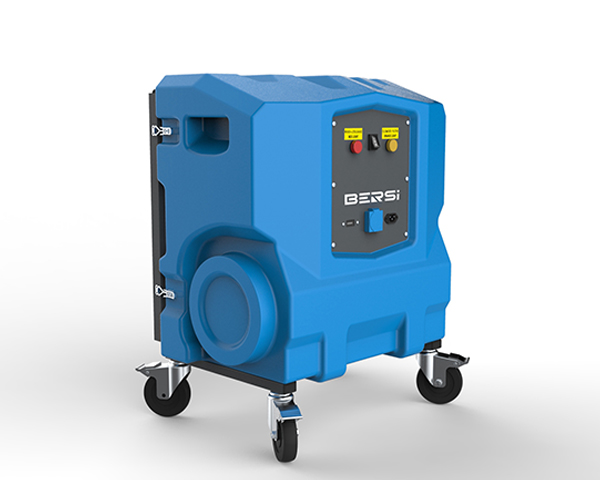
Bersi B2000 — 1200 CFM industrial HEPA air scrubber, rated for both air cleaning and negative air machine applications
What Is a Negative Air Machine — and Why Does It Matter?
A common feature of industrial air scrubbers (including the Bersi B2000 and B1000) is the ability to operate as a negative air machine. This means attaching ducting to the exhaust port and directing the filtered air outside the work area — to another room, outside the building, or into a duct system.
This creates negative pressure inside the work area: air flows inward from surrounding spaces rather than outward. Airborne contaminants (dust, mold spores, asbestos fibres) cannot escape into clean adjacent areas.
This mode is required in many regulated remediation scenarios:
● Mold remediation (IICRC S520 standard)
● Asbestos abatement
● Lead paint removal
● Controlled demolition in occupied buildings
Industrial vacuums do not have this capability. It is specific to air scrubbers with ducting options.
Do You Need Both?
In many professional environments, the answer is yes — but for different reasons.
Consider a drywall installation project in a commercial building:
● A HEPA dust extractor is connected to the sanding tool, capturing the bulk of fine gypsum dust at the source before it becomes airborne.
● An air scrubber runs throughout the workspace, capturing the residual fine particles that escape the extractor and treating the ambient air.
● At the end of the shift, an industrial vacuum cleans the floor and surfaces of accumulated debris.
Each machine has a distinct role. None of them fully replaces the others.
A simpler way to think about it:
|
Scenario |
Tool needed |
| Liquid spill on factory floor | Industrial wet/dry vacuum |
| Dust on workshop floor after shift | Industrial vacuum or dust extractor |
| Sustained dust generation during grinding | Dust extractor (at tool) + air scrubber (ambient) |
| Mold remediation in an enclosed space | Air scrubber running throughout |
| Post-fire soot cleanup | Vacuum (surfaces) + air scrubber (air) |
| General post-construction cleanup | Industrial vacuum |
Choosing the Right Bersi Product
For surface cleaning, liquid collection, and debris removal:
● Mixed wet/dry environments → BF584 Wet & Dry Industrial Vacuum
● Fine dry dust at the tool → Single Phase HEPA Dust Extractor
● High-volume continuous dust extraction → Auto-Pulsing HEPA Dust Extractor
For ambient air treatment and airborne particle control:
● Large spaces, heavy-duty use → B2000 Air Scrubber (1200 CFM)
● Smaller spaces, portable use → B1000 Air Scrubber (600 CFM)
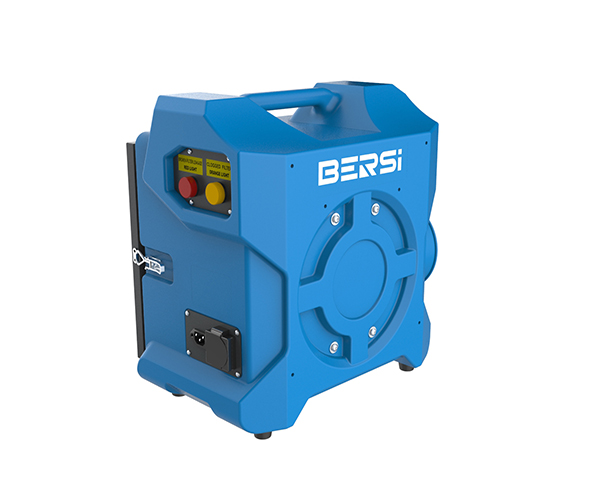
Bersi B1000 — portable 600 CFM air scrubber with 2-stage HEPA filtration, stackable for storage and transport
Not sure which combination is right for your facility? Contact the Bersi team with details about your environment and we’ll recommend the right setup.
Summary
|
Question |
Answer |
| I need to clean a floor or collect spills | Industrial vacuum cleaner |
| I need to clean the air in my workspace | Industrial air scrubber |
| I need to capture dust while I’m grinding | Dust extractor (connect to tool) |
| I need to prevent dust from leaving a containment area | Air scrubber in negative air mode |
| I generate both surface debris and airborne dust | Both — vacuum for surfaces, scrubber for air |
The industrial vacuum and the air scrubber are not competing products. They are complementary tools that address different dimensions of the same problem: keeping an industrial environment clean, safe, and compliant.
Explore Bersi’s full product range: Wet & Dry Industrial Vacuums | HEPA Dust Extractors | Air Scrubbers | Contact Us
Post time: Jun-24-2026