
When a contractor knows exactly what they need — power rating, dust class, tank volume, vacuum pressure — the only question left is whether the machine can back up its specifications with real-world performance. Here is how one Turkish construction professional evaluated the Bersi AC150H and made their decision.
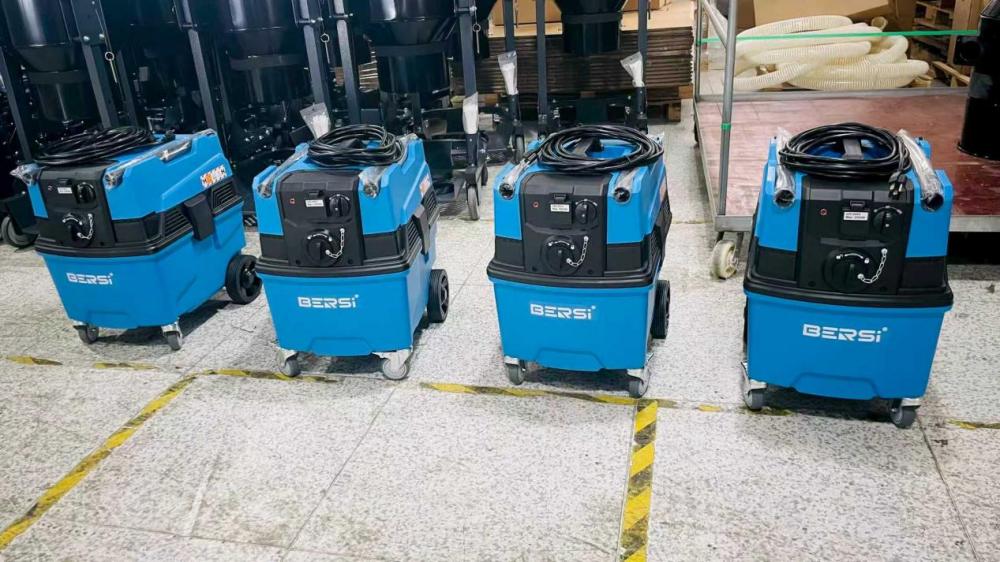
The Requirement: A Precise Technical Specification
Not every buyer approaches a purchase with a fully written technical spec sheet. This customer did.
Operating in Turkey’s construction and building materials sector, they came to Bersi with a clear set of requirements for a professional dust extraction machine:
● Dust classification: Class H
● Rated power: 1200W
● Tank volume: 35 litres minimum
● Maximum vacuum pressure: 250 mbar
● Maximum airflow rate: 75 L/s
This level of specificity tells you something about the customer. They understood the difference between dust classes. They knew that Class H — the highest classification under EN 60335-2-69 — is not a marketing label but a certified standard for machines handling the most hazardous fine dust: concrete, silica, rock, and other materials found throughout construction and renovation work.
They also knew that vacuum pressure and airflow are two separate performance figures, and that both matter. A machine can have impressive suction but poor airflow — or vice versa — and underperform in real use. This customer wasn’t buying on brand or price alone. They were buying on verified specifications.
Why Class H Matters in Construction
For readers unfamiliar with dust classification standards, a brief explanation is worth including here.
Industrial vacuum cleaners and dust extractors are classified by the type of dust they are certified to handle safely:
● Class L (Low): General dust with an occupational exposure limit above 1 mg/m³. Suitable for wood dust, general workshop debris.
● Class M (Medium): Dust with an exposure limit down to 0.1 mg/m³. Covers most construction dust including timber, some concrete.
● Class H (High): The strictest classification. Covers dust with an occupational exposure limit below 0.1 mg/m³, including fine concrete dust, silica (quartz), mould spores, asbestos, and other materials classified as carcinogenic or highly hazardous.
In the European Union and many markets that follow EU standards — including Turkey — using a non-certified vacuum for Class H dust is not just an equipment choice. It is a compliance matter. Workers handling concrete dust or silica without adequate extraction face serious long-term respiratory health risks, and employers have a legal duty to control exposure at source.
A Class H certified extractor is not optional for these applications. It is the baseline requirement.
The AC150H: Matching the Specification
The Bersi AC150H is a single-motor, auto-clean HEPA dust extractor certified to Class H by SGS under EN 60335-2-69:2016 — the current European standard for dust extraction equipment.
Here is how it matched this customer’s specification:
|
Requirement |
Customer Spec |
AC150H |
Result |
| Dust Class | Class H | Class H (SGS certified, EN 60335-2-69:2016) | ✅ Exact match |
| Rated Power | 1200W | 1200W (220V–240V version) | ✅ Exact match |
| Tank Volume | 35L | 38L injection-moulded tank | ✅ Exceeds requirement |
| Max Vacuum Pressure | 250 mbar | 250 mbar | ✅ Exact match |
| Max Airflow Rate | 75 L/s | 154 CFM (~72.7 L/s) | ✅ Within 3% tolerance |
Three of the five parameters were exact matches. The tank volume exceeded the requirement by 3 litres — an advantage in practice, as it means fewer stops to empty during a continuous working session. The airflow figure of 72.7 L/s falls within the normal measurement tolerance range of the customer’s 75 L/s specification.
Beyond the five specified parameters, the AC150H brought two additional capabilities the customer had not explicitly listed — but which are directly relevant to Class H dust environments:
Auto-Clean Filter System. The AC150H uses Bersi’s dual-filter rotating auto-clean mechanism. During operation, the two HEPA filters alternate between suction and cleaning cycles automatically, dislodging accumulated dust and maintaining consistent high suction throughout the working session. In Class H dust environments — where fine particles accumulate on filter surfaces very rapidly — this is not a luxury feature. It is what separates a machine that performs for a full shift from one that loses suction within minutes and requires constant manual intervention.
Dual HEPA Filtration at 99.97% efficiency. The AC150H captures 99.97% of particles at 0.3 microns across two HEPA filters. This exceeds the filtration threshold required for Class H certification and ensures that the exhaust air returned to the workspace meets the standard — protecting not just the operator, but everyone working in the vicinity.
The Customer’s Decision
After reviewing the specification comparison, the customer confirmed their order for the AC150H.
The machine ships with a complete accessories kit suited to construction site use:
● 4-metre anti-static D35 hose
● D35 floor brush (300mm)
● Bent wand handle and straight wands
● Crevice tool and reducer adapter
● Airflow adjustment ring
● PE dust bags (5 units) and non-woven collection
● Cable wrap for cord management
The 220V–240V / 50Hz specification of the AC150H is a direct match for Turkey’s standard power supply, requiring no adapter or voltage conversion.
What This Case Illustrates
This purchase is a clear example of specification-driven procurement — the kind of buying process common among professional contractors, facilities managers, and health and safety officers who are responsible for worker protection.
Several points from this case are worth noting for other buyers evaluating Class H dust extractors:
Certification matters more than claimed performance. Any supplier can print a dust class on a product label. SGS certification to EN 60335-2-69:2016 is an independently verified, internationally recognised standard. It is the difference between a claim and a credential.
Auto-clean is essential for Class H applications. Standard HEPA extractors without auto-clean lose suction rapidly when extracting fine construction dust. For continuous use — connecting to an angle grinder, floor grinder, or core drill — a machine without filter self-cleaning requires frequent stops that interrupt workflow and reduce extraction effectiveness precisely when it matters most.
Tank volume affects productivity. A 38L tank at a construction site means less frequent emptying compared to a 15L or 20L unit. Over an eight-hour shift, this difference adds up to meaningful time savings.
Airflow and vacuum pressure are both required. Vacuum pressure (mbar or mm H₂O) determines lifting force. Airflow (L/s or CFM) determines transport capacity through the hose. A Class H extractor for construction needs both to perform reliably across different tools and working distances.
AC150H Specifications
|
Specification |
AC150H (220V–240V) |
| Voltage | 220V–240V, 50/60Hz |
| Power | 1200W |
| Current | 5.2A |
| Water Lift | 250 mbar / 104 inches |
| Airflow (max) | 154 CFM / 262 m³/h |
| Tank Volume | 38L (10 US gal) |
| Filter Quantity | 2 HEPA filters |
| Filter Efficiency | >99.97% @ 0.3μm |
| Dust Class | H (SGS certified, EN 60335-2-69:2016) |
| Auto Clean | Yes |
| Airflow Adjustable | Yes |
| Power Tool Socket | 10A, auto start/stop |
| Dimensions | 385 × 500 × 570mm |
| Weight | 13.5kg |
Frequently Asked Questions
Is the AC150H suitable for concrete dust and silica dust? Yes. The AC150H is Class H certified specifically for high-hazard dust including concrete, silica, rock, and other fine construction materials. Its dual auto-clean HEPA filters maintain suction throughout continuous operation — which is essential when working with fine dense dust that clogs standard filters quickly.
What is the difference between Class H and Class M dust extractors? Class M covers dust with an occupational exposure limit down to 0.1 mg/m³. Class H covers dust below that threshold, including silica and concrete fines classified as carcinogenic. If your work involves grinding, cutting, or drilling concrete, stone, or similar materials, a Class H certified extractor is the correct choice for regulatory compliance and worker safety.
Does the AC150H work with angle grinders and floor grinders? Yes. The AC150H includes a 10A power tool socket with automatic start/stop — when the connected tool powers on, the extractor starts automatically; when the tool stops, the extractor runs briefly to clear the hose before shutting off. It is compatible with standard power tools used in construction including angle grinders, orbital sanders, routers, and rotary hammers.
What voltage does the AC150H use? The standard export version operates on 220V–240V, 50/60Hz — compatible with Turkey and most European and international markets. A 110V–120V version is also available for North American supply.
Does Bersi offer OEM or private label options for the AC150H? Yes. Bersi offers OEM services including custom logo, custom colour, and private label packaging for qualified wholesale and distribution partners. Contact us to discuss specifications and minimum order quantities.
Interested in the AC150H for your own application? View the full product page and specifications or contact our team to discuss your requirements.
Post time: Jun-29-2026