
Published by BERSI Industrial Equipment | bersivac.com
Last Friday, we reached out to a customer — Floor Masters Ltd, a professional flooring contractor — after noticing they were still active users of BERSI equipment purchased nearly six years ago.
Their reply was straightforward:
“We still use 3 of them (still have a brand new one unused). Great units, have only replaced 2 switches, and a flicker motor in the T503.”
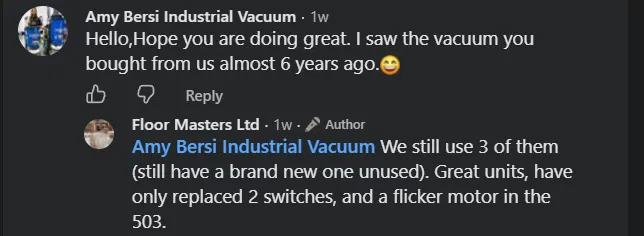
Three machines. Six years of professional use. Two switches and one motor across the entire fleet.
We didn’t publish this because it’s exceptional. We published it because it’s typical — and because what it reveals about the real cost of industrial equipment is worth spelling out clearly.
The Maths That Gets Left Out of the Purchase Decision
When a contractor or procurement manager evaluates dust extraction equipment, the comparison usually looks like this:
Machine A: $X Machine B: $X − 30%
Machine B wins on paper. The spec sheets look similar. The airflow numbers are comparable. The filtration ratings are the same on the label.
What the comparison doesn’t include:
- How long will Machine B hold those performance figures under sustained daily load?
- What is the failure rate of its components at year 2, year 3, year 4?
- When something fails — and something always eventually fails — how available are replacement parts, and at what cost?
- What is the productivity cost of a machine that’s down for a week waiting for a part that the supplier struggles to stock?
- What does it cost to replace the machine entirely at year 3 instead of year 6?
These numbers are invisible at the point of purchase. They become visible — sometimes painfully — over the operating life of the equipment.
What 6 Years of Data Actually Tells You
The Floor Masters Ltd feedback is worth reading carefully, because it contains specific information that generic warranty claims do not.
“We still use 3 of them” — three machines, all still operational after six years of professional flooring work. Not retired, not replaced, not sitting in a corner because a better option came along. Still working.
“Still have a brand new one unused” — they purchased four units and have held one in reserve. That’s a purchasing decision that reflects trust: when you know a product performs, you buy ahead.
“Have only replaced 2 switches, and a flicker motor in the T503” — this is the most telling detail. Across three machines over six years of daily professional use, the total maintenance intervention was two switches and one motor in one unit. That is an exceptionally low service cost for equipment operating in one of the most abrasive environments in the flooring industry — concrete and stone dust, continuous operation, the kind of conditionsthat expose weak components quickly.
Why Industrial Dust Extractors Fail Early (And How to Avoid It)
Most premature failures in dust extraction equipment trace back to a small number of design and manufacturing decisions:
Motor quality and specification. The motor is the heart of a dust extractor. A motor that is correctly specified for the application — with adequate thermal headroom, quality windings, and precision bearings — will run for thousands of hours. A motor sourced to hit a price point will show its limits under sustained load. BERSI uses Ametek bypass motors across its product range — the same motor platform used in demanding industrial vacuum applications globally.
Filter system design. A filter that cannot clean itself continuously will load up under heavy concrete dust, causing the motor to work against restriction — the leading cause of thermal motor failure in undersized or poorly designed extractors. BERSI’s patented Auto-Pulsing system keeps filters clean continuously, protecting the motor from the strain of restricted airflow.
Component tolerances and material selection. The switches, seals, hose fittings, and housing components that make up the rest of the machine vary enormously in quality across price points. In professional use, these components are handled daily, often roughly. The difference between a switch rated for 10,000 cycles and one rated for 50,000 cycles is invisible in the showroom and very visible at year three.
Manufacturing consistency. A well-designed machine built inconsistently will still fail unpredictably. BERSI manufactures at its own facility in Suzhou, China, with direct control over production quality at every stage — not a design that gets handed to the lowest-cost subcontractor.
Total Cost of Ownership: A Simple Framework
For any industrial equipment purchase, the relevant comparison is not unit price — it is total cost of ownership (TCO) over the expected operating life.
A simplified TCO for a dust extractor looks like this:
TCO = Purchase price + (Annual maintenance cost × Years) + Replacement cost × Replacement frequency
For a machine that costs 30% less but requires replacement at year 3 instead of year 6, and carries higher annual maintenance costs, the TCO over six years is frequently higher — not lower — than the premium option.
The Floor Masters Ltd case is a real data point in that calculation: four BERSI units purchased, three still running after six years, one held in reserve, total service cost of two switches and one motor. Whatever they paid per unit, the six-year TCO is low.
A Note to Distributors and Rental Companies
For distributors and rental operators, machine longevity is not just a cost question — it is a revenue question.
A rental machine that fails at 18 months is a machine that stops generating revenue, creates a customer service problem, and may need replacement capital before the first unit has been fully recovered. A machine that runs reliably for 6+ years generates revenue across its entire operating life, builds customer loyalty to the rental fleet, and carries far lower per-hour maintenance overhead.
BERSI works directly with distributors and rental operators across multiple markets. If you are evaluating the total economics of adding BERSI equipment to your fleet, we are happy to discuss the numbers.
The Standard We Hold Ourselves To
We follow up with our customers. Not because we are required to — but because we want to know how the machines are performing in real conditions, years after the sale.
The feedback from Floor Masters Ltd is the kind we aim to hear. It means the product did what it was supposed to do, for longer than the customer expected, at a lower maintenance cost than they budgeted for.
That is the outcome we engineer for.
Contact BERSI: info@bersivac.com | +86 150 5155 0390 | bersivac.com
BERSI Industrial Equipment Co., Ltd. — No. 2002, East Taihu Road, Wuzhong, Suzhou, China
Post time: Jul-16-2026